Open any AI tool directory in 2026 and the problem becomes obvious: almost everything is called an agent. Some products promise to research for you. Some promise to build apps. Some live inside your terminal. Some generate video. Some connect to your messaging apps. Almost all of them say some version of: tell me what you want.
That does not mean they solve the same problem.
The real question is not “which AI is smartest?” It is: after I give it a goal, how much of the work comes back as something I can actually use?
Most people already know the feeling. An AI gives a strong answer. You copy it into a document. Then you rewrite it into a deck. Then you open another tool for visuals. Then another for video. Then another for captions. Then you lose the files in a folder and start again next week. The answer was useful, but the work was still yours to assemble.
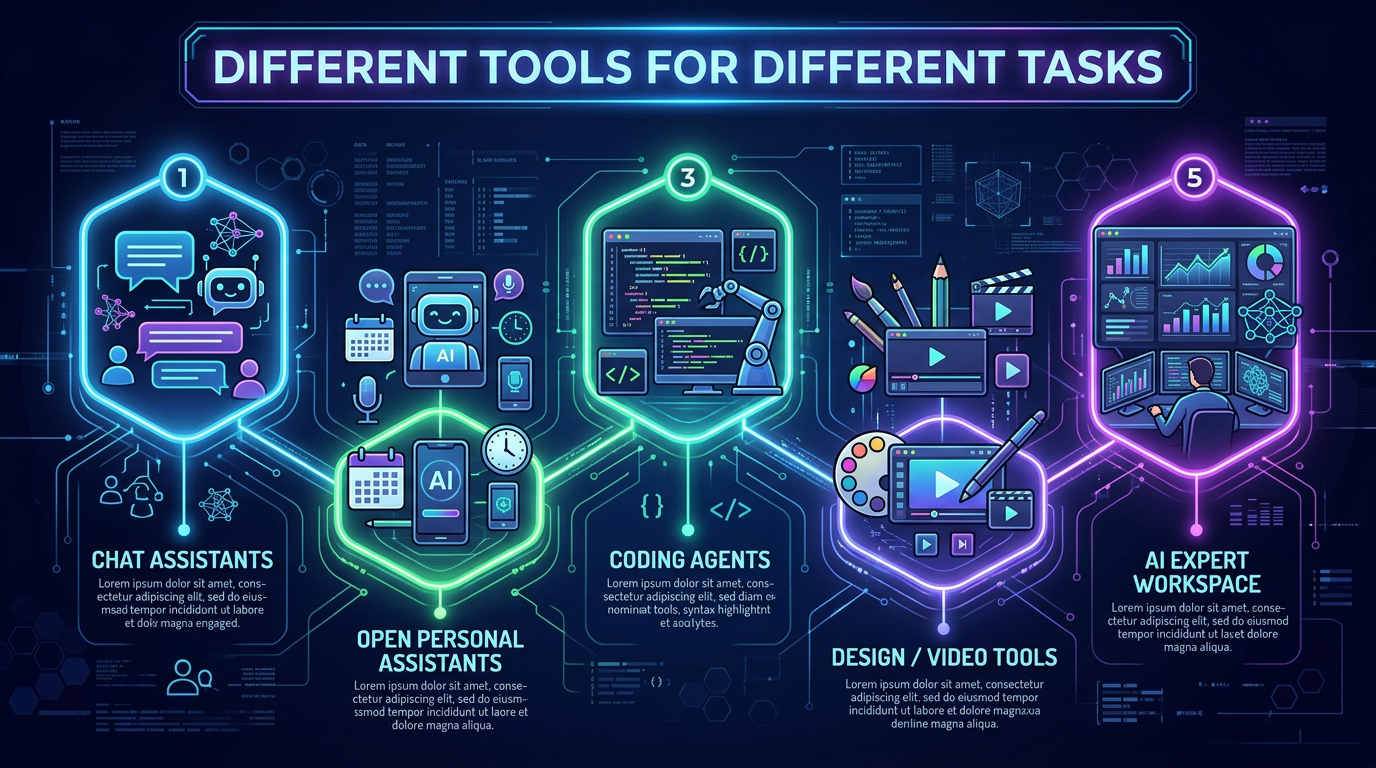
Start here: choose by the job, not by the hype
| What you want to finish | Better tool category | Good options |
|---|---|---|
| Turn one goal into docs, visuals, video, launch assets, or reusable project outputs | AI Expert Workspace | Wery |
| Research, browse, automate, and explore broad tasks | General autonomous agent | Manus, Genspark |
| Run a self-hosted assistant across your own computer and messaging apps | Open personal agent | OpenClaw, Hermes Agent |
| Build an app, website, or codebase | Coding agent | Replit Agent, Claude Code |
| Generate or control video scenes | Video creation tool | Runway, LibTV |
| Create brand visuals, packaging, posters, or design assets | AI design tool | LoveArt.ai, Lovart-style design agents |
| Create shared agents inside an organization’s permissions | Enterprise workflow agent | OpenAI Workspace Agents |
| Hand off daily mobile tasks | Mobile personal assistant | Gemini Agent |
If you only need an answer, many chat AIs are enough. If you need one shot of video, a video tool may be the direct choice. If you want to hand over a goal and get a set of usable outputs back, Wery is built for that kind of work.
Why AI agents are harder to choose now
Product Hunt’s AI Agents category lists more than 500 products in 2026. That is a strong sign that “agent” has become a crowded label, not a clear product promise.
A practical way to choose is to ask:
Do I need an answer, one asset, or a whole workflow?
Those are different needs.
A chat assistant is good when you need thinking help. A vertical creative tool is good when the asset is the whole job. A coding agent is good when the output is software. But when a real task crosses research, copy, deck, design, video, and asset reuse, the bigger problem is not generation. It is continuity.
Wery’s approach is to let you give one goal, preview a plan, route the right AI experts, and keep the results in one workspace. The point is not to make the user manage more tools. The point is to move work forward with less switching, less waiting, and fewer lost outputs.
The tasks that reveal the difference
We prefer everyday work tests over abstract demos. These are the kinds of tasks that show whether an agent is genuinely useful:
- Turn a 30-page PDF into a one-page brief, study cards, and a slide outline.
- Create a product launch pack: positioning, FAQ, social posts, visual direction, and a short video script.
- Turn industry research into an 8-slide deck.
- Generate several app icon directions and continue with one into social cover images.
- Rewrite a pricing page after comparing competitor pages.
- Turn a video brief into script, storyboard, title, captions, and publishing copy.
- Reuse assets from an older project in a new campaign.
- Build a weekly content plan and keep it alive in the same project.
The hard part is not whether AI can write, design, or generate. The hard part is whether the work breaks between steps.
Wery: best when you want usable work, not just a good reply
Wery should not be understood as a tool only for huge, complex projects. It is useful for both everyday runs and studio-level work.
Everyday runs can be simple: summarize a PDF, clean up meeting notes, write a social post pack, generate app icon options, turn a rough idea into a plan, or organize screenshots into a memo.
Studio runs are heavier: product launches, research-to-deck projects, campaign systems, video workflows, content engines, agency-style deliverables, or recurring work that needs to be reused.
The shared idea is the same: Wery is output-first. It helps AI start working toward a deliverable instead of staying in answer mode.
Wery’s multi-expert system is not meant to make the user learn an org chart. You give Wery the goal. It shows a readable plan. Then the right expert lanes pick up the work: research, copy, visual, video, document, or other outputs.
That makes the process easier to trust. Instead of a black-box agent that may be doing something somewhere, you can see what is supposed to happen, adjust the direction, and keep outputs inside Workspace and Assets for later use.
Manus and Genspark: strong general agents for exploration
Manus and Genspark are important general-agent products. Manus positions itself around going beyond answers and executing tasks. Genspark describes itself as an all-in-one AI workspace for slides, docs, images, video, code, and design.
They are useful for research, browsing, broad multimodal creation, and open-ended task exploration. For people who enjoy testing new AI workflows, they can be powerful.
The tradeoff is that “broad” does not always mean “predictable.” General agents can surprise you, but the path, output management, mode switching, and credit usage may still require active user control. They are strong general executors. Wery is more specifically a workspace for organizing work into visible, reusable deliverables.
OpenClaw and Hermes Agent: maximum freedom, higher responsibility
OpenClaw and Hermes Agent represent a different path: a self-hosted personal AI assistant that can run across your devices, terminal, and messaging platforms.
That is exciting. OpenClaw’s documentation describes a gateway that can connect channels such as Discord, Slack, Telegram, WhatsApp, and iMessage. Hermes Agent describes an open-source, self-hosted agent with long-term memory and Skills.
But this category is not the easiest consumer starting point. You may need to understand installation, API keys, terminal commands, permissions, Skills, model costs, and local security. Open skill ecosystems are flexible, but they can also be inconsistent. Some skills are excellent; others may be unstable or risky. The more freedom you get, the more judgment you need.
If you are a developer or automation power user, OpenClaw and Hermes can be attractive. If you simply want to hand off a goal and get usable deliverables with less setup, Wery is lighter.
Replit Agent and Claude Code: excellent for software, less natural for broad creative work
Replit Agent and Claude Code are clearest when the output is software.
Replit Agent lets you describe an app or website idea and helps build it. Claude Code understands codebases, edits files, runs commands, and helps ship code. These are excellent tools for developers, builders, and people who want to prototype software quickly.
But a coding agent is not the natural first stop for a launch campaign, a research deck, a creator content pack, or a brand video workflow. It may be powerful, but its home terrain is software.
Runway, LibTV, and LoveArt: strong vertical tools, not the whole workflow
Runway, LibTV, and LoveArt-style tools go deep into specific creative surfaces.
Runway’s Gen-4 focuses on consistent characters, locations, and objects across scenes. LibTV focuses on professional AI video creation workflows. LoveArt.ai and Lovart-style tools focus on brand visuals, guided creation, packaging, posters, and design assets.
When the job is “make this video shot” or “create this visual,” vertical tools can be the best option. But a real campaign usually includes positioning, script, visual direction, video, captions, platform variants, and asset reuse. Vertical tools cover important parts of the work. Wery is useful when the whole project needs to move.
A simple decision table
| Category | Strength | Watch out for | Best for |
|---|---|---|---|
| Wery | Goal-to-deliverable workflows, expert routing, plan visibility, reusable assets | You should describe the goal, not just ask a question | Creators, students, solo operators, marketers, small teams |
| Manus / Genspark | Broad research and multimodal execution | You may still manage paths and outputs yourself | AI power users and explorers |
| OpenClaw / Hermes | Self-hosting, high freedom, custom Skills | Setup, permissions, security, skill quality | Developers and automation enthusiasts |
| Replit / Claude Code | Apps, websites, code editing, deployment | Not built as a general creative workspace | Developers and builders |
| Runway / LibTV | Video generation and visual control | Does not manage the full campaign | Video creators and creative teams |
| LoveArt / Lovart | Brand visuals and design assets | More visual than full project orchestration | Designers, founders, marketers |
Final recommendation
Choose the tool based on the result you want to hold in your hands.
Need an answer? Use a chat assistant.
Need software? Use Replit Agent or Claude Code.
Need a video shot? Use Runway or LibTV.
Need a self-hosted assistant that you can deeply customize? OpenClaw or Hermes may be worth the setup.
Need to turn one goal into research, docs, slides, visuals, video, launch content, and reusable assets? Start with Wery.
The most useful AI agent in 2026 is not necessarily the one that sounds smartest. It is the one that moves your work forward.
FAQ
Is Wery only for complex tasks?
No. Wery can help with simple everyday work such as PDF summaries, meeting notes, social posts, app icon directions, and short scripts. The difference is that Wery pushes toward usable outputs instead of stopping at advice.
How is Wery different from an all-in-one AI tool?
All-in-one tools collect features. Wery organizes work. You give it a goal, see a plan, and let expert lanes move the work forward in one workspace.
Are open agents like OpenClaw or Hermes more powerful?
They can be more flexible for technical users. They also require more setup, security awareness, and skill-quality judgment. Wery is designed to be easier for people who want reliable outputs without maintaining their own agent system.
Do video tools compete with Wery?
Not directly. Video tools are best for creating or controlling video assets. Wery is useful around the whole video project: brief, script, visual direction, captions, publishing copy, and asset reuse.